Our New Graphic's Capabilities
Leavitt & Parris' reputation for innovation is why we have been asked to act as a beta test site for new print technologies by partners like HP, Dupont and Gerber. From fabric printing, direct to substrate imaging, and now latex printing, we have built our reputation as experts in the industry with high expectations for quality and commitment to sustainable solutions.
Our latest investment has been the HP DesignJet L65500, which uses a latex based ink to create an incredibly high quality, low cost alternative to solvent printing.
- Incredible outdoor durability, 5-8 years. Comparable to traditional solvent printing.
- Brilliant color with exceptional image clarity. Impressive at even the closest viewing distances for indoor applications.
- No harmful VOC's are emitted during production. We do not need to provide special ventilation or material handling for the inks, nor does our production staff need special safety equipment.
- No noxious odors and no-post manufacture off-gassing of VOC's. Prints can be used for retail interiors without creating an unhealthy environment.
- Wide variety of printable materials available including alternatives to PVC. This solution is truly more sustainable than other technologies.
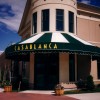
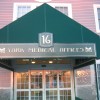
A variety of methods are used to apply graphics to the awning.
- Silk-screening
Graphics of almost any complexity can be accurately transferred to the awning through the use of screens cut specifically for the application. Ink is spread evenly over the top of the screen and "printed" onto the face of the fabric. Silk-screening is an excellent method for ensuring consistent quality in multiple applications, and can be an economical way to apply graphics where a large quantity is involved.
- Painting
Hand painting is the most traditional and often the most economical method of applying graphics. Hand painting the graphics directly onto the awning, with materials selected specifically for fabrics can provide a customized effect to any awning. When two-color effects are required, many manufacturers recommend spray-on air brushing methods, which can achieve color blending or shading. Typically graphics are drawn onto the awning and then blocked out with a masking compound. The entire awning is then spray painted in one or more colors, while the awning is on the frame. This method produces an even consistency of paint application and a smooth finish.
- Cut-Out Lettering
In applications where easy readability is essential, cut-out lettering is an excellent and economical method to apply simple graphics to the awning. Letters and/or graphics are actually cut out of the fabric and replaced from behind with letters or graphics cut from a second translucent fabric.
- Pressure-Sensitive Graphics
Simple to moderately complex graphics can be applied with great accuracy through the use of pressure-sensitive vinyl films. The films are cut by hand or by computer to a desired design and then placed in the proper register on the fabric.
- Eradicating
Eradicating is usually used for illuminated awnings. It involves eliminating, with special chemical, an existing color from a white vinyl fabric that has been percolated at the factory with eradicable inks.
- Digital
Digital printing is the method of using computers to create and manipulate digital files with the use of one or more of the many graphics software programs available. Pixels (dots) on a field are arranged, colored and manipulated until the desired image is perfected and then is reproduced on a physical surface such as paper, film or cloth using any one of a wide range of printers specifically designed to accept and transfer (inkjet, laser, etc) such images.
There are two types of digital printing: direct and dye sublimation. Dye sublimation printing is performed by first printing the image onto paper and heat pressing it into the fabric. Direct digital printing is printed onto paper backed fabric, the color is set with steam, and then the fabric is washed and dried. Some printers are now available to print onto fabric up to π-inch thick, eliminating the need for paper-backed fabric.